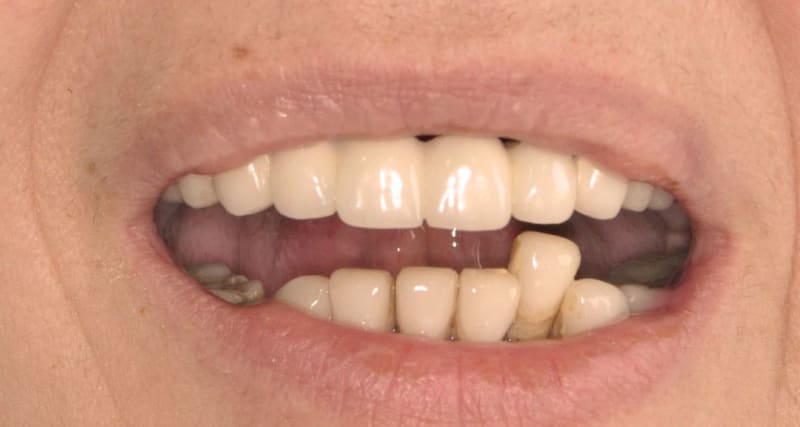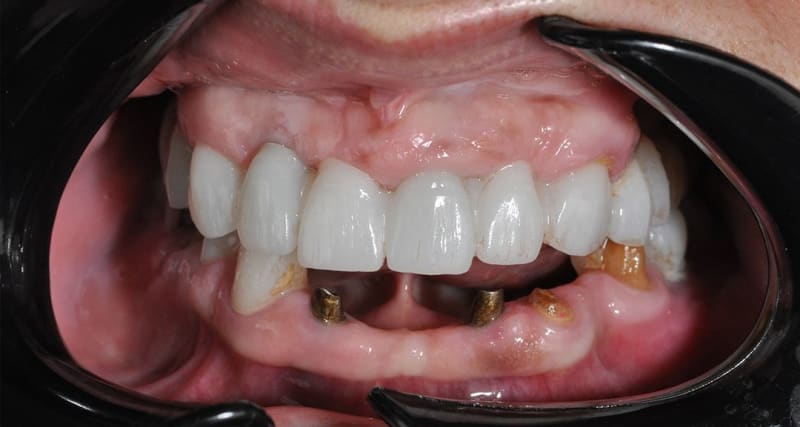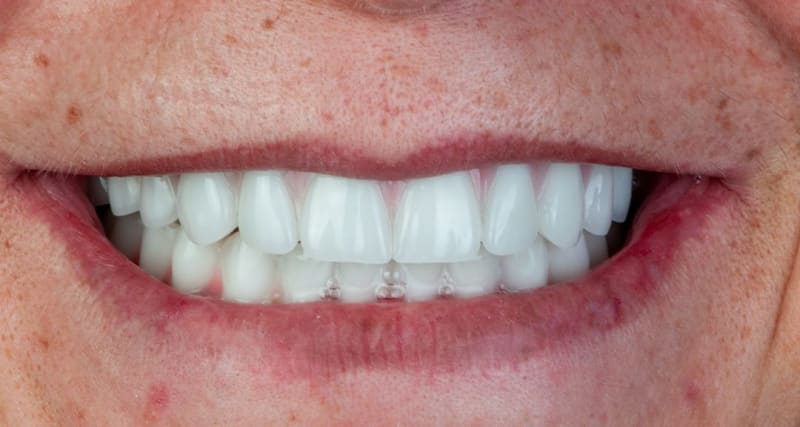
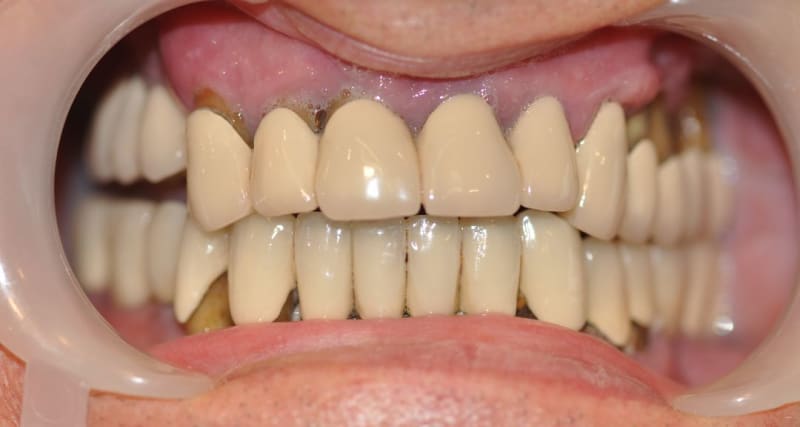
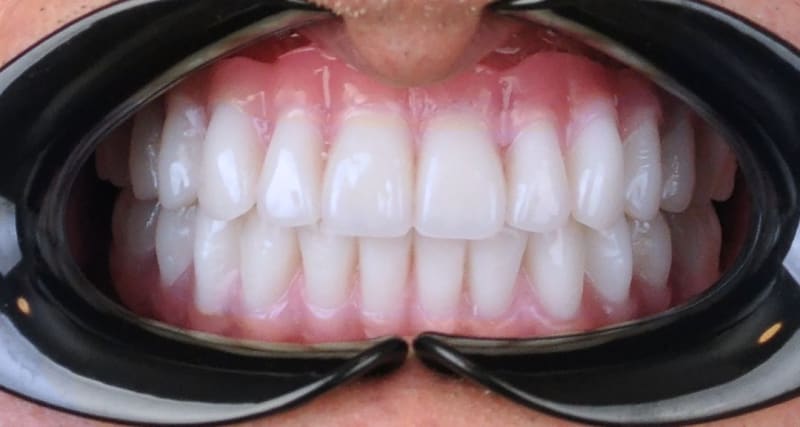



Full mouth dental implants provide a fixed, long-term treatment option designed to restore chewing function, speech, facial support and the appearance of the smile. Depending on the patient’s condition, treatment may involve the upper jaw, lower jaw or both arches—particularly when the remaining teeth can no longer be predictably preserved.
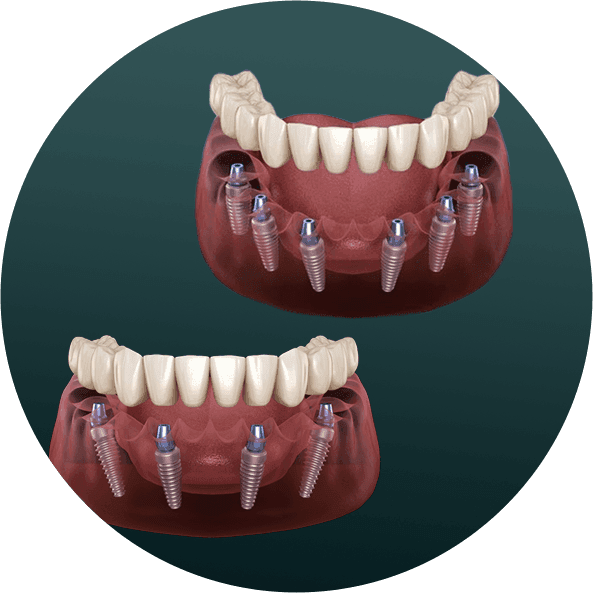
A separate implant is not required for every missing tooth. Instead, strategically distributed implants are used to support a complete set of replacement teeth. Common treatment configurations include All-on-4 and All-on-6. Depending on the patient’s anatomy and prosthetic requirements, segmented implant-supported bridges or removable implant-supported prostheses may also be considered.
Every full-mouth reconstruction requires an individual surgical and prosthetic plan. The number and position of implants, the possible need for bone grafting or other preparatory procedures, the loading protocol and the final prosthetic material are determined after evaluating the patient’s 3D CBCT scan, bone distribution, bite forces, remaining teeth, oral health and medical history.
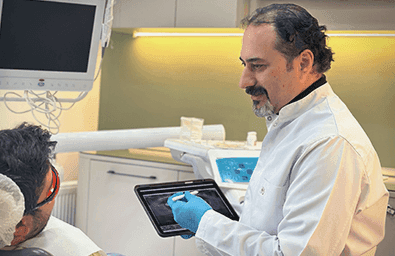
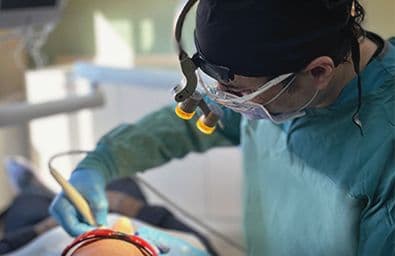
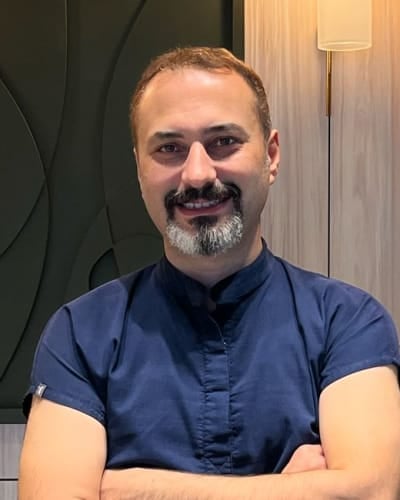
At Dera Dental, every full-mouth implant case is personally evaluated, planned and followed by Dr. Ali İlker Baştan (DDS, MSc, PhD). As an oral and maxillofacial surgeon with approximately 25 years of clinical experience in complex implant dentistry, Dr. Baştan oversees both the surgical and prosthetic stages. Following a clinical examination and three-dimensional assessment, he explains which implant configuration and prosthetic design are most appropriate for the patient’s individual clinical needs.
At Dera Dental, full mouth implant treatment is not planned as a standard package applied in the same way to every patient. Dr. Ali İlker Baştan personally evaluates and follows each case, from the initial surgical planning to the fitting of the final prosthesis.
Our first priority is to preserve natural teeth that can be maintained with a predictable long-term prognosis. Full-mouth implant treatment is recommended only when the remaining teeth cannot be reliably preserved or when one or both arches are already completely edentulous.
The same implant configuration does not have to be used in both jaws. Depending on the available bone, anatomical structures and prosthetic requirements, Dr. Baştan may recommend All-on-4 in one arch and All-on-6 or another configuration in the opposing arch. The treatment is based on clinical need rather than applying the highest possible number of implants.
Implant positioning and the design of the final prosthesis are planned together from the beginning. Particular attention is given to implant distribution, primary stability, bite balance, opposing teeth, bruxism, facial and soft-tissue support, prosthetic material and the patient’s ability to clean beneath the restoration.

Usually two visits: approximately 5 days for the surgical stage and 7 days for the final prosthetic stage, with a healing period of approximately 3–6 months between visits.

Full-mouth implant treatment starts from €5,650 per arch. The final cost depends on the implant configuration, implant system, prosthetic material and any additional procedures required.

We provide a lifetime warranty for the implant body and a 5-year warranty for the final prosthesis, subject to the conditions stated in our Guarantee Policy.


All-on-4 per arch
All-on-4 per arch
All-on-6 per arch
All-on-6 per arch
Your Treatment Journey, Step by Step


Additional procedures are not performed routinely. Depending on the patient’s CBCT findings, clinical examination and individual treatment requirements, the following may require separate planning and pricing:
Important: Flights, personal expenses and companion accommodation are not included unless specifically stated in the individual package. Any additional procedure and its cost are discussed and confirmed with the patient before treatment.

Our full mouth dental implant packages include the following services unless otherwise stated in the patient’s individual treatment plan:
The exact implant system, number of implants, temporary and final prosthetic designs, hotel stay and transfer arrangements are clearly stated in the patient’s written treatment plan.

The appropriate treatment is determined by the patient’s bone distribution, anatomical limitations, bite forces, remaining teeth and prosthetic requirements. The same implant configuration does not have to be used in both jaws.
All-on-4 uses four strategically positioned implants to support one fixed full-arch prosthesis. It may be considered when four favourable implant positions can provide suitable support, particularly when the available bone is concentrated in the anterior and premolar regions.
All-on-6 uses six implants per arch. When sufficient bone is available at six appropriate positions, the broader distribution may help spread functional forces across more support points. However, a higher number of implants does not automatically provide a better result.
Patients with advanced bone loss in the upper jaw may require extensive bone reconstruction or an alternative solution such as zygomatic implants. This decision requires detailed CBCT evaluation and individual surgical planning.
Dr. Ali İlker Baştan selects the treatment according to the clinical support each implant can provide—not simply the highest possible number of implants.
Full mouth dental implants may be considered for patients who have lost most of their teeth or whose remaining teeth can no longer be predictably preserved. However, our clinical philosophy is clear: natural teeth with a maintainable long-term prognosis should be preserved whenever possible.
To determine whether this treatment is appropriate, Dr. Ali İlker Baştan evaluates the patient’s bone volume and distribution, gum health, general health, medications, smoking and nicotine use, bite forces, bruxism and long-term maintenance requirements. These factors help determine the number and position of implants, the possible need for additional procedures and the most suitable prosthetic design.
A final treatment plan cannot be confirmed from photographs alone. A clinical examination and three-dimensional CBCT assessment are required to evaluate the available bone, anatomical structures and proposed implant positions before the individual treatment plan is finalised.

Before treatment planning, patients must provide complete information about their general health, current medications, allergies and previous medical treatments. Diabetes, anticoagulant or antiplatelet medication, antiresorptive drugs such as bisphosphonates or denosumab, previous head and neck radiotherapy, smoking and other nicotine use may affect surgical planning and healing.
These conditions do not automatically exclude every patient from implant treatment. Dr. Ali İlker Baştan evaluates each patient individually and may request blood tests or consultation with the patient’s physician. Prescribed medication must not be stopped, reduced or changed without medical advice, and elective surgery may be postponed when a medical condition is not adequately controlled.
Clinical sources: American Dental Association – Diabetes, American Dental Association – Anticoagulant and Antiplatelet Medications, AAOMS – Medication-Related Osteonecrosis of the Jaw


The procedure is performed under an anaesthesia protocol selected according to the patient and the extent of surgery, so pain should not be felt during the operation. Pressure or vibration may still be perceived.
Swelling, bruising, tenderness and temporary discomfort are normal after full-arch implant surgery. These symptoms can generally be managed with prescribed medication, supportive IV therapy and postoperative care instructions.
Treatment is usually completed over two visits to Istanbul. We generally recommend approximately 5 days for the surgical visit and 7 days for the final prosthetic visit, with a healing period of approximately 3–6 months between them.
A longer stay or additional visit may be required if extensive bone reconstruction or staged surgery is necessary.
Dental implants are designed to function for many years, but no implant or prosthesis can be guaranteed to last forever. Longevity depends on bone and gum health, oral hygiene, smoking, general health, bite forces, bruxism and regular professional maintenance.
The implants and final prosthesis do not necessarily have the same lifespan. Even when the implants remain healthy, the prosthesis may eventually require maintenance, repair or replacement.
Yes. A temporary prosthesis is included during the healing period. When adequate primary implant stability and suitable surgical conditions allow immediate loading, a fixed temporary prosthesis may be provided shortly after surgery.
If immediate loading is not considered sufficiently predictable, Dr. Baştan may recommend delayed loading and an alternative temporary solution to protect the implants during healing.
Depending on the individual case, we use internationally established implant systems including Straumann, Nobel Biocare, Neodent—a Straumann Group brand—and German-made Bredent implants.
Dr. Ali İlker Baştan selects the implant system according to the patient’s bone anatomy, implant positions and prosthetic requirements. The recommended system and the reasons for its selection are explained before treatment begins.
Bone loss does not automatically prevent implant treatment. Depending on the available bone and planned implant positions, additional procedures such as bone grafting, guided bone regeneration, ridge augmentation or sinus lifting may be required.
In selected patients with severe upper-jaw bone loss, Dr. Baştan may consider an alternative implant configuration or zygomatic implants. A clinical examination and CBCT evaluation are required to determine the appropriate approach.
Per arch means either the upper or lower jaw. If both jaws require treatment, each arch is planned and priced according to its individual implant configuration and prosthetic requirements.
The upper and lower jaws do not automatically require the same number, type or brand of implants.
Yes. A companion may travel and stay with you. However, hotel accommodation and personal expenses for a companion are charged separately unless they are specifically included in your individual package.
Our team can explain the available room and hotel arrangements before you confirm your treatment dates.
The final prosthetic material is selected according to the patient’s bite forces, bruxism, available restorative space, opposing dentition and clinical requirements. Depending on the case, Dr. Baştan may recommend a zirconia restoration or a bar-supported hybrid prosthesis.
The final material and prosthetic design are explained and stated in the individual treatment plan before the definitive prosthetic stage.
Implant placement and a temporary prosthesis may be completed during the first visit. However, the final prosthesis is generally fitted after an osseointegration period of approximately 3–6 months.
Marketing claims such as “permanent teeth in a few days” may refer to a temporary immediately loaded prosthesis. At Dera Dental, immediate loading is recommended only when implant stability and surgical conditions are suitable.

Oral and Maxillofacial Surgeon